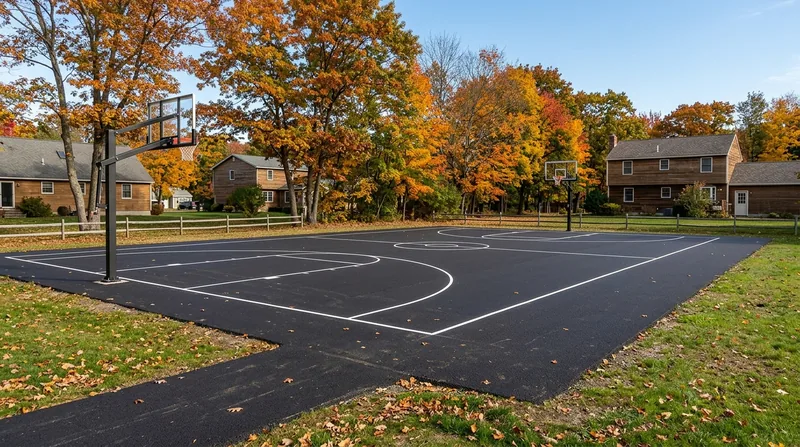




Sports Court & Path Paving in Bangor requires a foundation that survives the region's deep frost cycles, heavy snow loads, and the freeze-thaw damage that cracks and heaves ordinary bases every spring. Bangor's terrain runs from steep hillside lots downtown to flat subdivision ground pushing toward Brewer and Hampden, and both work for a paved court or path if the base is built right. We grade and compact the aggregate base, then lay hot mix asphalt pitched to drain so your basketball court, tennis court, or recreational path holds up through long, snowy winters and the brutal thaw that follows. The Penobscot River valley sits on glacial marine clay and silt that holds water and moves with frost, so proper drainage and a solid binder course separate a court that lasts ten years from one that cracks and fails in three. We've been building asphalt surfaces in Greater Bangor since 2010, and we know what the ground beneath demands.
Why Sports Court & Path Paving Matters in Bangor's Climate and Terrain
Bangor's winters are long and hard, with snow depths that push plows and salt into every edge. The freeze-thaw cycle here runs deep, with frost reaching 60 inches or more into ground that started as clay left by glacial melt. A poorly prepared base under a tennis or basketball court will heave and crack within the first two seasons, leaving you with a surface that pools water, buckles in the middle, and becomes unsafe for play. The right asphalt court sits over a compacted aggregate base that sheds water away from the playing surface and allows the ground beneath to move without fracturing the top.
- A properly graded and drained base prevents water from pooling under the court and pushing the asphalt up in spring.
- Hot mix asphalt laid over a solid binder course distributes foot traffic and equipment weight so the surface stays smooth and safe for years.
- Pitch and crown direct meltwater and rain away from the court so play is not interrupted by standing water or ice.
- Aggregate base depth and compaction are the difference between a court that lasts and one that fails before the loan is paid off.
The investment in a proper sports court base pays back in safety, playability, and years of use without costly repairs.
Key info: Bangor's deep frost and clay soil mean that a court base must be engineered to move without cracking. We compact the aggregate to proof-roll specifications and lay the asphalt in two courses (binder and top) so the court survives the freeze-thaw cycle that destroys single-course work.
How We Build a Sports Court & Path Paving System in Bangor
The process starts with site grading and base preparation. We remove unsuitable soil, bring in compacted stone aggregate to the depth and grade required by the court type and local conditions, then proof-roll the base to confirm it will not move under load. Once the base is locked in place, we lay a binder course of hot mix asphalt, then finish with a top course crowned to shed water. The entire system is designed to drain, move with the ground without cracking, and provide a consistent, safe playing surface for years.
- We measure and grade the site to establish proper drainage and eliminate low spots where water pools.
- Aggregate base is delivered, spread, and compacted to specifications that match Bangor's frost depth and soil type.
- Proof rolling confirms the base will not settle or move under the weight of play and equipment.
- Binder course asphalt is laid hot and compacted to lock the base in place and provide a stable bed for the top course.
- Top course asphalt is finished with the proper crown and texture for safety, playability, and drainage.
From site survey to final finish, we handle every step so your court is ready to play on and built to last. For pathways and recreational trails, the same principles apply: proper base, correct pitch, and hot mix asphalt that sheds water and resists frost heave.
Example: A residential basketball court in Hampden started with clay and organic matter. We excavated unsuitable material, brought in 18 inches of compacted aggregate, proof-rolled it, then laid a 2-inch binder and 1.5-inch top course. The court is now in its sixth season with no cracking or heave, and the homeowner maintains it with simple sweeping and occasional pressure washing.
Sports Court & Path Paving Methods and Approaches
| Approach | Description | Best for |
|---|---|---|
| Full-Depth Court Construction | Excavate unsuitable soil, install compacted aggregate base, lay binder and top courses of hot mix asphalt with proper crown and drainage. | New basketball, tennis, or recreational courts where soil conditions are poor or frost heave is a risk. |
| Existing Surface Overlay | Mill or grind existing asphalt to remove surface damage, then overlay with new hot mix asphalt if the base is sound. | Courts with good base structure but worn or cracked top surface; faster and less expensive than full replacement. |
| Recreational Path Paving | Grade and drain a pathway corridor, compact aggregate base, then lay hot mix asphalt with slight crown for water runoff. | Walking and cycling paths, trail access, and connecting routes on residential or HOA property. |
| Patching and Spot Repair | Cut out failed sections and patch with new asphalt, compacting and finishing to match the surrounding court surface. | Courts with isolated cracks, potholes, or edge damage that do not require full resurfacing. |
Sports Court & Path Paving Cost in Bangor: What to Expect
A residential sports court or recreational path in Bangor starts at around $8,500 for a small court (roughly 2,000 to 2,500 square feet) with good existing soil and simple access. The cost rises with court size, excavation depth, the volume of unsuitable soil that must be removed and replaced, and site drainage complexity. A full-depth tennis court or a larger recreational area with poor soil conditions and difficult grading will run significantly higher, often $15,000 to $25,000 or more depending on what the ground requires. Getting written estimates from two or three contractors is the only way to understand what your site actually needs and what it will cost.
Factors that move the cost up include excavation of unsuitable clay or organic matter, extended site grading to achieve proper drainage, the need for imported aggregate if the site has no suitable base material, and any utility locates or permitting required by the city. We provide tonnage specifications and a detailed breakdown so you understand exactly what is being installed. Learn more about our full pricing and what drives the cost of asphalt work in Bangor.
Sports Court & Path Paving Near Me: What Bangor Homeowners Should Know When Hiring
Finding the right contractor for a sports court or path means verifying that the work will be done with proper site preparation, correct material specifications, and attention to Bangor's specific soil and frost conditions. Ask any contractor for a written estimate that includes base depth, aggregate type and tonnage, asphalt course thickness, and the grading plan. Check references from other court or path projects in the area, and confirm that the contractor understands local permitting for work at the property line and any driveway apron or culvert involvement.
We are fully insured, and we can provide references from Bangor, Brewer, Hampden, Orono, and surrounding communities. Maine does not license asphalt paving contractors, but the city of Bangor and surrounding towns control permits for work at the street line and driveway entrance, so verify with your local building department whether your court or path requires a permit. If your property is in an HOA community, check the architectural standards to confirm that asphalt is an approved surface material. Contact us for a free estimate and we'll walk you through the process and answer any questions about permits or what your site needs.
Sports Court & Path Paving in Bangor: Pricing Guide
| Service | Price | Details |
|---|---|---|
| Small residential sports court (2,000-2,500 sq ft) | Starting at $8,500 | Includes site grading, compacted aggregate base, binder and top course asphalt, proper drainage and crown for water runoff |
| Medium court or recreational path (3,000-4,500 sq ft) | Starting at $12,000 | Cost increases with excavation depth, unsuitable soil removal and replacement, and complexity of site drainage and grading |
| Full-depth court with poor soil or extensive grading | On estimate | Sites with clay, organic matter, or poor drainage require site visit to determine excavation depth, aggregate volume, and drainage system cost |
| Overlay of existing court surface (if base is sound) | Starting at $4,500 | Milling or grinding existing asphalt and laying new top course costs less than full reconstruction if the base structure is intact and stable |
| Travel and estimate | Included and free | No mileage fee or call-out charge for Bangor and surrounding service areas; estimates provided within 24 hours at (207) 605-5037 |
Indicative pricing, the exact cost depends on square footage, finish, and site access. Free personalized estimate within 24h at (207) 605-5037.


